
Flowise
ArchivedOpen source, drag-and-drop builder for AI agents and LLM workflows. Now archived (EOL Aug 2026) — the Apache 2.0 code lives on for forks and self-hosters.
Project status: Flowise has been discontinued. Active development stopped in July 2026, the GitHub repository was archived on August 13, 2026, and official support ended on August 31, 2026. The Apache 2.0 source remains available to self-host or fork.
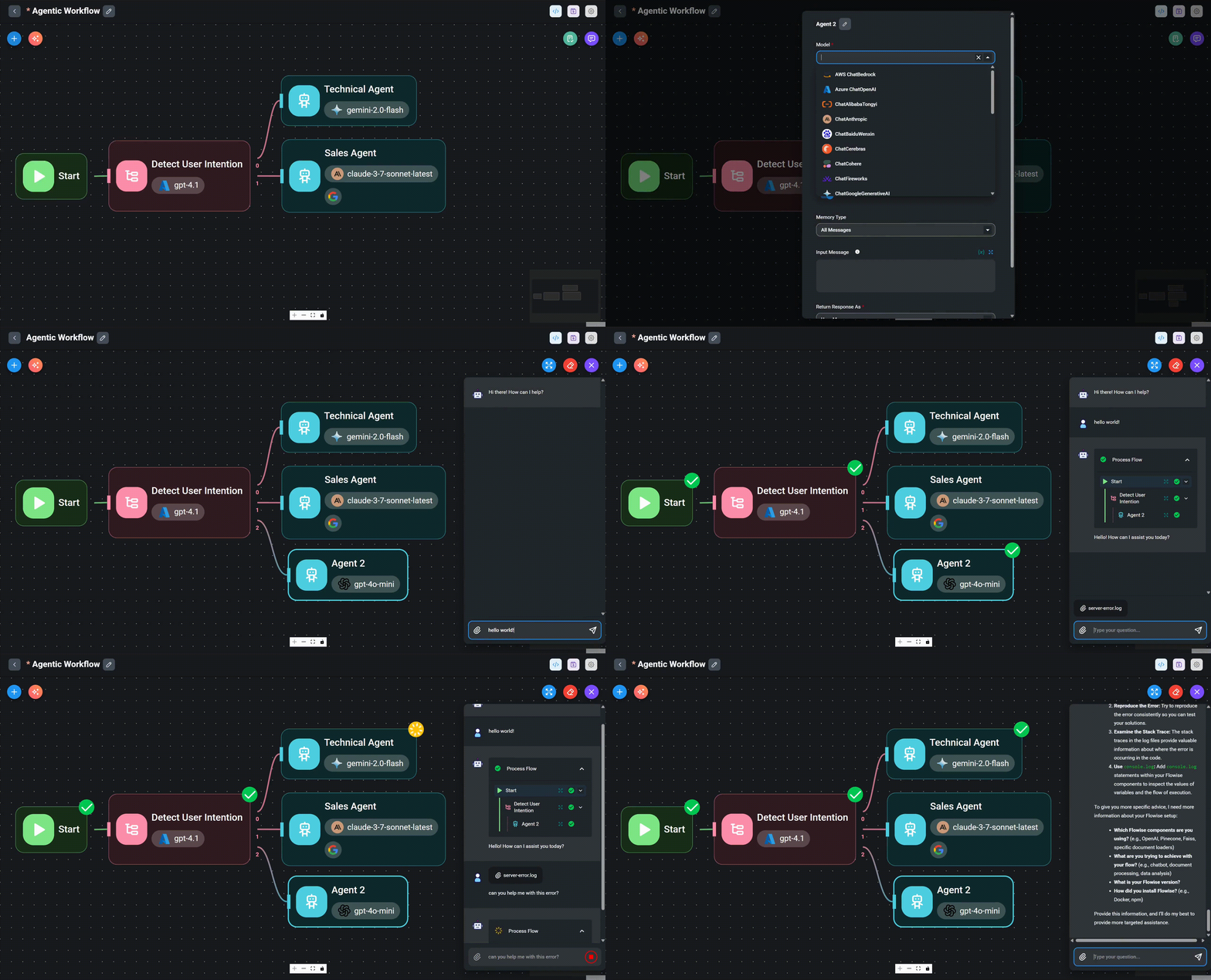
Flowise is an open source, low-code platform for building AI agents and LLM-powered applications through a visual, drag-and-drop interface — think of it as "AI LEGO." Instead of starting from code, you assemble chatbots, RAG pipelines, and multi-agent workflows by connecting nodes on a canvas, then deploy them as APIs or embedded chat widgets. With more than 55,000 GitHub stars, it became one of the most popular projects in the AI agent builder space.
Flowise offered three builders for different levels of complexity:
- Chatflow — flexible chatbots and single-agent workflows using advanced RAG, retrievers, and rerankers
- Agentflow — multi-agent orchestration with branching, loops, parallelization, and hierarchical logic
- Assistant — beginner-friendly agents that follow instructions, use tools, and answer questions from uploaded files
Core features include:
- 100+ integrations with LLM providers, vector stores, tools, memory, and external services
- A visual canvas with branching, looping, custom code, and logic routing
- Observability through execution logs, visual debugging, and external log streaming
- API access to every flow, plus JavaScript and Python SDKs, a CLI, and auto-generated Swagger docs
- Embedded chat widget, template marketplace, and reusable components
- Enterprise features such as SSO, RBAC, encrypted credentials, rate limiting, and scaling for high-throughput workloads
Under the hood, Flowise is a TypeScript monorepo: a Node.js backend that executes flows and serves them over REST, a React frontend for the drag-and-drop editor, and a components package containing the third-party integration nodes.
Self-hosting options:
- npm — install with
npm install -g flowiseand runnpx flowise start(requires Node.js ≥ 20), then openhttp://localhost:3000 - Docker — a standalone image and a docker-compose setup ship with the repository
- One-click templates — AWS, Azure, GCP, DigitalOcean, Railway, Render, Hugging Face Spaces, and others
- A hosted Flowise Cloud offering was also available
Flowise launched in 2023, was backed by Y Combinator, and grew a user base spanning indie makers to enterprises. After end of life, the core team ships no further updates or security patches — if you rely on Flowise today, plan to run your existing self-hosted instance as-is, maintain a community fork, or migrate to another open source agent builder.
Categories:
Build with:


Frequently Asked Questions
What is Flowise?
Flowise is an open source, low-code tool for building AI agents and LLM applications visually. You connect nodes on a drag-and-drop canvas to create Chatflows (chatbots and single-agent workflows with RAG), Agentflows (multi-agent orchestrations), and Assistants, wire them to 100+ integrations such as LLM providers and vector stores, and publish each flow as an API or embedded chat widget. Note that its development was discontinued in 2026.
Is Flowise still maintained?
No. The core team announced that Flowise would wind down in July 2026 and froze the codebase, archived the GitHub repository on August 13, 2026, and ended official support on August 31, 2026. Pull requests and issues are locked, and the npm packages and Docker images are deprecated.
Can I still self-host Flowise?
Yes. Existing installs keep working and new installs are still possible: install with npm install -g flowise and start with npx flowise start (requires Node.js 20+), or run the Docker/docker-compose setup. There will be no further bug fixes or security patches, so for production use consider forking the repo or moving to an actively maintained alternative.
What license does Flowise use?
The core source code is released under the permissive Apache 2.0 license. Only the enterprise package in packages/server/src/enterprise (SSO, RBAC, workspace features) is under a commercial license. Because Apache 2.0 is fork-friendly, the community is free to maintain its own versions of the platform.
What are open source alternatives to Flowise?
Similar open source, visual builders include Langflow and Dify, while n8n covers agentic workflow automation. Since Flowise's code is licensed Apache 2.0, forking it and maintaining your own version is another option.
OpenAltFinder Score
Project Details
Repository activity
Sponsor Flowise
Compare Flowise with
Similar open source alternatives

n8n
Fair-code workflow automation platform with native AI capabilities. Combine visual building with custom code, self-host or cloud, 400+ integrations.
 Make
Make
Huginn
Self-hosted automation platform for building agents that monitor and act on your behalf — a hackable, open source alternative to IFTTT and Zapier.
 IFTTT
IFTTT
Apache Airflow
Apache Airflow is a platform to programmatically author, schedule, and monitor complex workflows. Build pipelines as code and orchestrate your data jobs with rich observability.
 Zapier
Automatisch
The open source Zapier alternative. Build workflow automation without spending time and money.
Zapier
Automa
Browser extension that automates repetitive web tasks by visually connecting blocks — no code required.
Zapier
Rowboat
Open-source desktop AI coworker with a living knowledge graph, built-in email, browser, meeting notes, and code mode.
 Notion